
Bethlehem Directory Collections
The useful historical directories for Bethlehem are concentrated at the Bethlehem Public Library Local History Room, the Town Historian collection, and NY Heritage. They are not one uninterrupted city directory run. Instead, early Delmar material, a suburban volume, long-running Tri-Village books, telephone excerpts, maps, and obituary tools overlap in different ways. The right starting point depends on the date and whether the address was identified as Delmar, Elsmere, Slingerlands, or another hamlet.
| Collection | Years | Where held | Access |
|---|---|---|---|
| Delmar residential or family directory | 1913 | Library local history and historian summary | Check the local collection for the surviving copy |
| Tri-City Suburban Directory | 1926 | Library and Town Historian materials | Inspect the original for its exact street coverage |
| Tri-Village Directory | 1932-1993 | Library; compiled through First United Methodist Church | Local volumes, with some digitized editions |
| NY Heritage Tri-Village collection | 24 items; includes 1982-83 | NY Heritage and Bethlehem Public Library | Browse digitized page images online |
| Telephone-directory excerpts | 1908, 1909, 1917 | Town Historian and local-history collection | Useful clues, not a complete roll |
Directories record a publication-time snapshot. An omitted name may reflect a move, a choice not to be listed, a missing page, or a volume that did not cover that street. Keep the edition date beside every note, and retain the printed village abbreviation rather than silently converting it to a modern mailing label.
The 1913 Bethlehem Directory
Delmar had an early residential source before the better-known Tri-Village run. The Town Historian summary identifies a 1913 Delmar residential directory, and a 1988 Spotlight library-history article calls it the 1913 Family Directory of Delmar. The Delmar Progress Club published it to raise money for the library, giving the book a local origin story as well as a research value. It is an early name-and-residence lead, not a substitute for a deed or a census schedule.
Source image: the Bethlehem Public Library Local History page identifies the room where directory, map, microfilm, yearbook, obituary, and family-history work can be brought together.
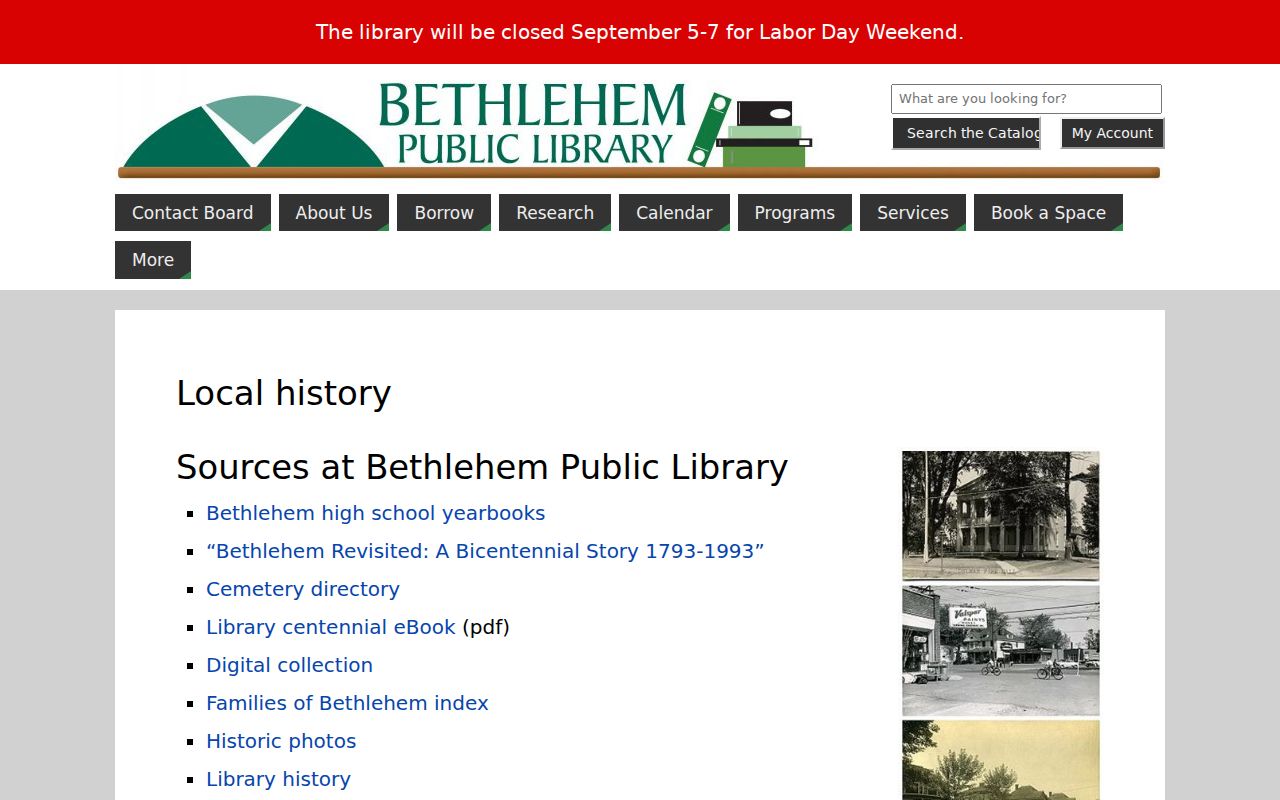
The library route matters because a directory name needs local context. Staff assistance, the Information Desk, and the Local History Room provide the published volumes and related collections, while access conditions can differ by resource.
Note: a directory entry supplies a dated lead, so verify it with a contemporary map, newspaper, deed, census record, or vital-record source when the conclusion matters.
Bethlehem Directories From 1932
The Tri-Village Directory ran from 1932 through 1993 for Delmar, Elsmere, and Slingerlands. The historian summary says the volumes can include names, spouses, children, addresses, maps, and community information. A later account described optional occupation details for both spouses and broad local listings. Those fields describe a historical publication. They should be read as dated context, not as a current-person record.
The digitized NY Heritage Tri-Village Area Directories collection has 24 items and was created by the Tri-Village Area Directory Association. Its collection description says the books list adults alphabetically for Delmar, Elsmere, and Slingerlands. Browse the page images rather than assuming every issue has the same layout or survives in the same condition.
Source image: NY Heritage presents the Tri-Village directory collection as a digitized local-history resource.
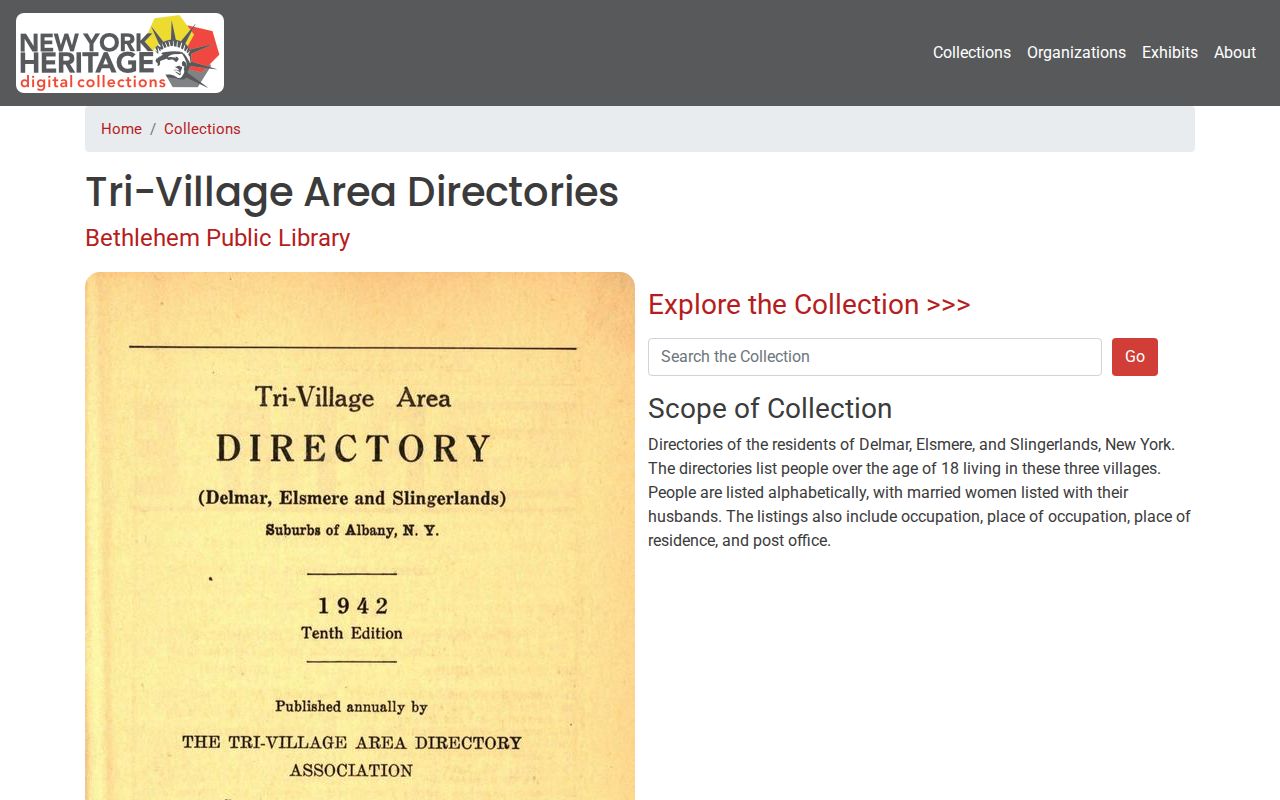
For a printed name, record the book title, edition, page, and hamlet label first. That small discipline makes it much easier to return to the exact evidence after comparing another year.
The surviving sequence gives the directory era a practical timeline:
- 1908, 1909, and 1917: telephone-directory excerpts provide early, limited name and address clues.
- 1913: the Delmar family directory preserves an early residential snapshot tied to the Progress Club.
- 1926: the Tri-City Suburban Directory adds a suburban Albany and Bethlehem-context volume.
- 1932-1993: Tri-Village editions form the long local run, with selected material later digitized.
How Bethlehem Directory Entries Read
A digitized 1982-83 page in the local collection shows how compact these lines can be. It uses a surname and first name or title, sometimes a spouse in parentheses, and markers such as Mrs. or Jr. The same line can carry an occupation or business reference, a street number and street name, and a village abbreviation. The printed form is useful precisely because it preserves the source's shorthand instead of turning it into a modern database record.
| Name line | Surname, given name or title, with relationship markers such as a spouse in parentheses or Jr. |
|---|---|
| Work detail | An occupation or place-of-work fragment may appear, but the fields vary by edition. |
| Address | Street number and street, followed by a village abbreviation such as -Del or -Els. |
| Household clue | Spouse and other printed relationship detail can help distinguish people with similar names. |
| Catalog caveat | The 1982-83 metadata notes that original pages 129-132 are missing. |
- Criss-cross directory
- An address-order section, when a volume includes one, that helps move from a street to the listed household.
- Householder index
- A name index organized around the principal listed person, not a promise that every resident appears.
- Abbreviation key
- The publisher's explanation of its short forms. Photograph or transcribe it before interpreting a line.
Missing Pages in Bethlehem Directories
A skipped surname can be a catalog problem rather than a family-history answer. The metadata for the 1982-83 digitized volume identifies missing original pages 129-132. The Bethlehem Public Library obituary index has a different break: Albany County Post notices run from November 1927 through December 1957, while Spotlight obituaries begin in January 1983. The library specifically notes a 1957-1983 gap in that obituary index.
When an online result is silent, use the library obituary index to identify the date range, then ask the Information Desk about the Albany County Post microfilm or the digitized Spotlight material. The library notes Albany County Post microfilm for 1927-57 and Spotlight material for 1957-2011. Absence in a web index is not proof that an obituary or a household record never existed.
Bethlehem Library Directory Routes
The Local History Room is more than a shelf of directories. Its published resources include high-school yearbooks, historic photographs, a cemetery directory, local-history files, maps, microfilm, the Spotlight archive, a marriage index, and the Families of Bethlehem index. That index reaches back as far as 1647 for more than 150 families, but the library describes family submissions as unverified. Treat those entries as leads and verify them with primary evidence.
The Bethlehem Historical Association adds a museum, local-history contact route, and oral-history work with the Town Historian and Library. Its Selkirk location offers a complementary setting for local questions that reach beyond a printed directory.
Source image: the Bethlehem Historical Association is an established local-history contact for museum and oral-history resources.
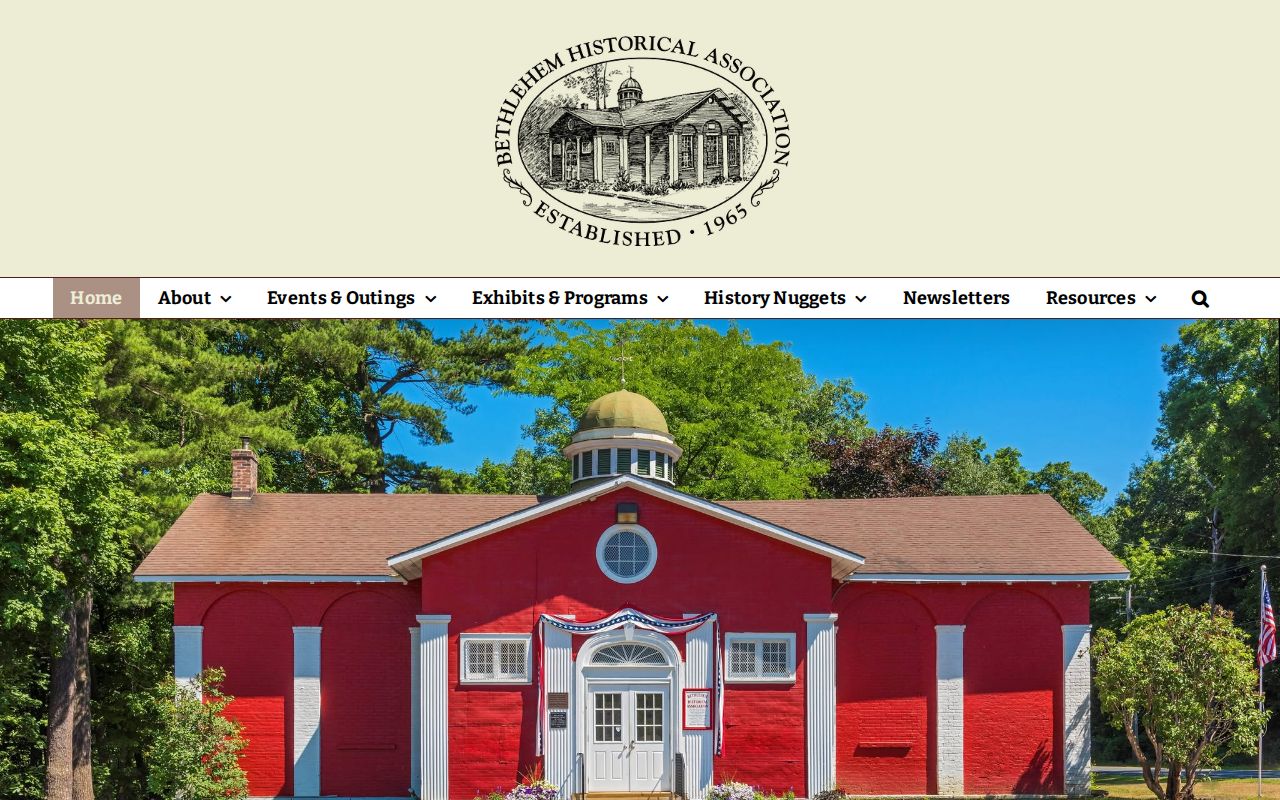
The association does not turn an old listing into proof. It helps connect a directory clue to photographs, oral history, and the local repository network.
Trace Households in Bethlehem Directories
Follow a household through more than one edition. Start with an exact surname or address, note the hamlet and post-office label, then look both forward and backward in the sequence. A change in spelling, initials, marriage notation, or street line is a prompt to check another record, not a reason to combine people too quickly. Published directories are especially helpful between census years because they create dated stops along a longer trail.
- Find the closest directory edition and copy the printed name, address, village abbreviation, and page number exactly.
- Check the prior and next available editions for a move, a changed spouse marker, or a missing listing.
- Pair the directory date with the nearest released federal schedule, and use the 1915 or 1925 New York census through Archives resources where appropriate.
- Compare an obituary, cemetery lead, map, or deed name before treating a similar entry as the same household.
- For current address-keyed records after the historical trail ends, use the Town property and deed route rather than extending an old directory forward.
Directory volumes are the historical shelf; the modern address chain belongs on the Town of Bethlehem Street Directory. Keeping those two tasks separate avoids treating an older printed listing as proof of who is at an address today.
Bethlehem Historian Record Files
The Town Historian and Town Archives offer another layer when the directory stops. Historian genealogy reports and documents span 1680-1980 and can contain legal, marital, burial, school, land, and family-Bible leads. The Archives says its records are segregated by origin, and that many town records route through the Town Clerk. The historian can help people research official town records, but does not perform individual historical or genealogical research in that role.
A local record trail also has a documented statewide break. The 1911 State Capitol fire destroyed New York State census schedules for 1801-1905, while the State Archives retains unindexed 1915 and 1925 schedules. For a household that falls in that loss period, combine the surviving directory, land, cemetery, newspaper, and historian evidence rather than expecting a state census return.
Note: retain a source note for each edition, archive item, and image because the date and repository are as important as the name you found.